Pages

Sunday, September 23, 2018

To Whom It May Concern

Dear (Please Insert Your Name),

Before I get down to start sharing what I am going through from past couple of years, I want to put down some questions for you, and if you are reading this, try and share your answers, they are just random questions, it won’t necessarily enlighten me about the subject, but at-least I’ll have a perspective to look at it:

Photo by Andre Mouton on Unsplash


How does rejections (not merely in professional front, but also from a personal point of view) affect your outlook towards life?
What is your first impression of an emotionally broken person?
How does one cope up with the guilt that is driven by being dishonest with your own ambitions?
Which is more important, being in love with someone special, or be loved by someone special?
Is being mediocre or average a bad attribute?
Do the books we read define us the kind of person we are, or the kind we want to be?

First important thing that I want to tell you, if you are reading this, “I love you” (Obviously not in a romantic manner, because then it would be awkward for me and for you as well), but in a more genuine and straightforward manner, something which I have been lacking in my life for the past two and half years, to tell people what I actually feel about them rather than telling  what they want or expect to hear from me. I have come to realize this, that love gives us this opportunity to finally be more of ourselves, and if something is able to provide us those walking ground and space, it sure must be utilized very delicately and smartly. I will specifically emphasize on two words, delicacy and smartness because without the presence of these two attributes, that space will slowly get more generic and will lose its essence.  

I’ll start this letter with the iconic epilogue from the Johnny Depp and Penelope Cruz starrer 2001 movie, “Blow” which has stayed subconsciously with me, for reasons still unknown to me. 

So, in the end, was it worth it? Jesus Christ. How irreparably changed my life has become? It's always the last day of summer and I've been left out in the cold with no door to get back in. I'll grant you I've had more than my share of poignant moments. Life passes most people by while they're making grand plans for it. Throughout my lifetime, I've left pieces of my heart here and there. And now, there's almost not enough to stay alive. But I force a smile, knowing that my ambition far exceeded my talent. There are no more white horses or pretty ladies at my door”  

I have this recurring nightmare, that I am about to die, and I say these lines, not to anyone but myself, and then I wake up terrified. We will get back to this part later.

There are certain moments over a period of time that stays with you, and whenever you think about that time, it makes you smile, you cherish each and every moment of that time, in my case that period lasted for about 25 months. I realized the nervousness of what it feels like to be in love with someone who has a pensive pair of eyes, I experienced what it feels like to have your name printed under the logo of an international journal, what it feels like to be in your own personal happy space, be content with what you are doing in present, and somewhere planning what you are going to do in future, I bid goodbyes too, some happily, and some out of circumstances. Goodbyes are always tough, you have this constant fear inside you that the time gap will change you and the person, if you are lucky enough to meet them again, how will the dynamics work out? and if you try and ignore the goodbyes, and act as emotionally non-vulnerable person (which I did, and still practice a lot of times), it just hits you in the face sometimes randomly that you might not be able see that person again, that’s a difficult spot to be in.   

Then life happened. A small-town guy trying to make a living in a big city, totally lost under the train of his own thoughts about survival, felt the transition from living life into surviving one, and that transition left a sort of fear inside me, a fear of undefined nature, perhaps, the low confidence to face people, the act of trying to balance life between living and surviving was and still is bloody exhausting but what still kept me going was my ambition, and if you know me even the slightest, you’ll know what the ambition was………’is’.

Sometimes it amazes me, how detached I get with people, yet contradictorily, I think a lot about the moments I spent with them. It’s such an ambiguous feeling that I cannot come into a conclusive outcome about my nature, again, the question arises in my head, do I really need to find that conclusive answer or should I just give myself this age-old theory that this is how life is supposed to be, you spent some moments with some people, then everyone gets busy in their own lives, the distance starts developing gradually, and once that distance is long enough, life throws around more emotional speed breakers (insecurities, regrets, angst, anger, misunderstandings) to make sure you do not even try and cover it, I know I am sounding too shallow by making it sound like this is all because of life, and acting as a victim and making life principle antagonist of the journey, whereas in reality, one might tell that these situations in life are driven through my actions only.  

Have you ever wondered why most of us only tend to recall moments which were too happy or extremely sad, we find hard to recall any random moment from the past which was uneventful, “we are acclimatized in such a way, things can only be white and black” is not the answer I am looking for?

Last year, a friend of mine sent me a hand-written letter with a copy of “The Raven” from the great Edgar Allan Poe, I always re-read that letter and book to understand why I have not been able to follow all those words of advice that she had very accurately pointed out, I still judge people on the basis of their actions, I have still not learned how to love myself more openly, and yet to learn that sometimes, a clear ‘No’ is important.

I am still trying to contemplate the relationship between personal triumph and empathy. Does one even exist between them? If so, how does on draw lines to separate their own individual importance.

Last two years have been quite a roller-coaster ride, despite coming so close to my dream, I couldn’t make it, have seen someone close die a very painful death, got rid of my insomnia without depending on any pills, left two ‘safe’ jobs only because I was treated like a piece of shit (I am being told by few people that it’s because I am one), have experienced how quickly people around you change when you are unemployed, and have nothing much to offer (in terms of money, words or your presence). Perhaps the reason for my recent absent-minded behavior is the culmination of the anger and bitterness that is building up inside me for the last two years. This is the reason why the epilogue of “Blow” has felt so important and relatable, I do not want life to pass by me while I am making grand plans for it and going through my own share of poignant moments, and despite leaving pieces of my heart at certain stages to certain people, there should be enough room for my heart to stay alive.

I recall that time of life, when I developed interest in playing squash, I got a great kick out of it, even though I never won a single game, and every day after facing defeat, the next day I would tell myself, “C’mon man, at-least win a game” and again face defeat, so my life in the past two and a half years is on the same lines, I face defeat on every level, the next day I get up and tell myself “C’mon man, at-least win this one”. In due time, I might get my win, till then persistence is the key.

So, it is befitting to say that I am left with two options, to remain in this constant absent-minded overthinking phase, and let what should be the most defining years of my life pass by me, and let it make me toxic at some point ahead (the symptoms are already there), or I should just get the fuck out of this confused indecipherable phase without any drama, and attempt. Just put up a more honest fight to reach that place where I have been dreaming to see myself. At-least I am willing to put up a fight, and as Gulzar Saab has written in one of his recent songs “दिल पत्थर हो जाएगा, या पत्थर का दिल धड़केगा

One of the most influential books in my life is “The Zahir” written by Paulo Coelho, and at some point, in the book, it is mentioned “It's not my story anymore: whenever I speak about the past now, I feel as if I were talking about something that has nothing to do with me. All that remains in the present are the voice, the presence, and the importance of fulfilling my mission. I don't regret difficulties I experienced; I think they helped me to become the person I am today, I feel the way a warrior must feel after years of training; he doesn't remember the details of everything he learned, but he knows how to strike when the time is right.”

I am deeply flawed, but I am also learning to love myself,

With Love,
Mandeep  

Sunday, September 2, 2018

Song of Love: Chup Chup Ke from 'Bunty Aur Babli'

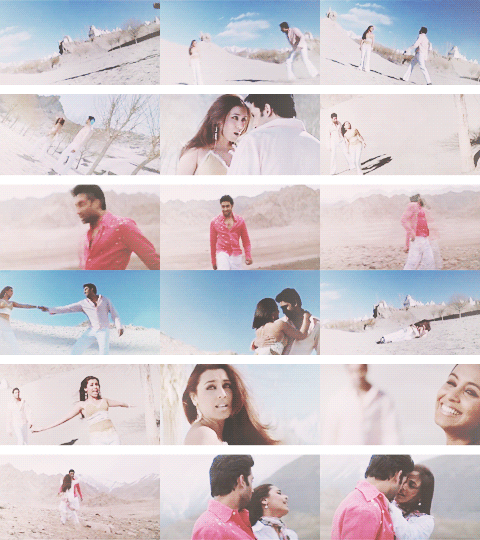
Written by the wizard of words, Gulzar Saab, composed by the sensational and versatile trio of Shankar-Ehsaan-Loy, the melodious voices bestowed by Sonu Nigam, Mahalaxmi Iyer, the song “Chup Chup Ke” from the Shaad Ali directed 2005 film ‘Bunty Aur Babli’ is simply not about Bunty and Babli, it’s a song culminating from the love fashioned between Rakesh Trivedi and Vimmi Saluja. The song juxtaposes the dual personalities that both Rakesh and Vimmi hides inside themselves in the form of their aspirations and dreams. So, to represent their romance, it becomes important to have a song that highlights both forms of the couple. The sound of piano that initiates the song represents the intimacy of their first kiss, just like the tunes coming out of a piano, the kiss that both Bunty and Babli share is highly seductive in its nature. The song then quickly shifts into the sound of Sitar, arranged by Niladri Kumar. The initial part of the song which starts with a piano and transforms into Sitar distinguishes the contradiction between the two personalities of the couple. The former, westerns in its aspirations, while the later representing the Indian-ness of their love.


Source: Tumblr


We quickly cut to a wide landscape of mountains, “देखना मेरे सर से आसमाँ उड़ गया है” sings Rakesh, as if telling Vimmi how jealous is the sky of their newly found love, and is reorganizing itself from the universe courtesy brought by the fanaticism of their love. Vimmi replies “देखना क्या हुआ, ये ज़मीं बह रही है, देखना पानियों में, ज़मीं घुल रही है कहीं से” the earth too is influenced by their love, and is ready to get submerged in water. The comparison between the two entities, Sky and Earth and their reformation, probably in their own way trying to get the feel of the taste of love, the lines are constructed in typical Gulzar-esque fashioned style to define the love between these two characters. It is also a symbol that much like the big ambitions that these two people have, the canvas of their thoughts is also larger than life. It’s as if the love between these two characters is acting as a conductor in an orchestra and directing the sky and earth to perform as per their words. The theme, idea and the interpretation of their love directed towards the sky and earth is what it makes it even more beautiful, because then the understandings will be in large number and in a deeper sense.    


We then see a change in characters in the song in the next scene, we see Bunty and Babli going around in a car, probably after a con job, and they make love in the car randomly in the middle of an empty road, the reason I say they are Bunty and Babli, because we do not hear a word, throughout the scene, all we get to hear is a tune of Piano, and when they do get inside of the car, we see a bundle of rupees flying away without neither of them bothering about it, that signifies the people we see on the screen.


We quickly cut back to Rakesh singing “होश में मैं नहीं, ये गशी भी नहीं, इस सदी में कभी, ये हुआ ही नहीं” he is sharing his state of confusion in his mind about his identity, he is muddled about the issue that whether the person in love is Rakesh or Bunty, because he hasn’t felt like this before, he has felt the highs of a successful con job gone right in the past, but the ecstasy of being in love is way above everything else in the world, and to be honest, at this point he just does not care about his dual personality, he simply wants to be in this moment of love. He does not know what the future holds for him, he just wants to be in the present, because he is in love and wants time to be paused and let him be absorbed in the moment. “जिस्म घुलने लगा, रूह गलने लगी” replies Vimmi, simply telling him that now, apart from partners in crime, they have become one soul, they both have amalgamated into one another, “पाँव रुकने लगने ,राह चलने लगी” up till that point, they were running towards one goal after another, but now Rakesh and Vimmi have come out of Bunty and Babli, and they have found stability in life, and now they do not run towards their path, the are static in their place, it’s the road of love they are walking together that is driving them towards their pathway, which is different from the idea that Bunty and Babli have in their mind.


We get back to both of them speaking once again about the sky and earth, and in a way, they are providing us updates about the sky and earth’s quest to restructure themselves. “आसमाँ बादलों पर करवटें ले रहा है, देखना आसमाँ ही बरसने लगे ना ज़मीन पे” the anxiety is getting into the nerves of the sky, and that might eventually lead to a point where the sky would roll around the clouds in order to pour down into the earth. “ये ज़मीं पानियों में डुबकियाँ ले रही है, देखना उठ के पैरों पे चलने लगे ना कहीं पे” announces Vimmi. This stanza of the song clears my ambiguity about the use of the words, sky and earth, the lyrics are trying to tell an individual story in itself, between sky and earth, both of them are envious of the love between Rakesh and Vimmi that they are witnessing in front of them, this ignites the fire of love in them, and they desperately want to sneak near each other for a couple of moments of proximity. The distance between them is too large to be fulfilled, instead both Rakesh and Vimmi are sharing their longing for one another through their words which are embedded in music.

We then cut back to Bunty and Babli having a glass of champagne in the middle of nowhere, and ironically for the first time, we hear these characters sing “छुप छुप के, चोरी से चोरी”. We see them running into an uninhabited lane, probably after a heist gone wrong, they try and hide around a corner, but at this particular moment, both of them are struck with the realization of being this intimate with each other. As they get closer with each other, we see a couple of people carrying flambeaus in the background. This is a very subtle hint on the director’s part to show the flames of love burning inside them, as they make love while running away from a theft, they are not one bit concerned about any other aspect at that moment apart from feeling each other’s love. As they make love, Bunty pulls the pearl necklace from Babli’s neck, this gives me another hint that the pearl necklace broken so passionately was stolen.


Just before the song, there is a beautiful sequence around the banks of Taj Mahal with a man singing on the outskirts, as if providing Rakesh and Vimmi a marriage song. Both of them take their marriage vows, and promise each other that they will forever remain as Bunty and Babli, fatefully once they are done with their proceedings, Vimmi tells him “Oye Rakesh, Just Married”. Shaad Ali is probably fascinated with the idea of his characters being in love around and with Taj Mahal. Ricky Thukral and Alvira Khan’s love was similarly made memorable in “Bol Na Halke Halke” from “Jhoom Barabar Jhoom”, where Ricky proposes Alvira for marriage, and we hear a man singing in the background. 


तुम कहो तो रुकें, तुम कहो तो चलें, ये जुनूँ है अगर, तो जुनूँ सोच लें” sings Rakesh, solidifying the marriage vows he took, that he will take every important step in life in accordance with Vimmi, if their dynamics is termed as some sort of fixation by the world, then let it be the measuring stick for the feeling of obsession. The play of words describes the beauty and the epic nature of what it means for these characters to be in love. The fixation that is driven through love is much stronger than the core feeling, and Rakesh is even to willing to prove it. “तुम कहो तो रुकें, तुम कहो तो चलें, मुझको पहचानती, है कहाँ मंज़िले” says Vimmi, she will be unfamiliar to her destination without him, and if she is alone, even her destinations won’t recognize her.


The song culminates with the line “बंटी की बबली और बबली का बंटी, बंटी की बबली हुई”, leaving it for the audience to decide whether they see Bunty and Babli, or Rakesh and Vimmi. The song has so much depth to offer about the romantic side of these two couples, and the way they perceive romance. On one side, we have a couple acting as a mediator to narrate the tales of an immature but fantasy love between sky and earth, while on the other side we have a couple, who is naughty at every inch of their skin, and is looking to explore the moment of being ‘High’ when in love. We have a couple representing small towns of India, and on the other end, we have a couple showing urges of urbanized lifestyle.

Chup Chup Ke, probably got lost in the chaos of the lyrical and musical genius of Kajra Re, but the way this song provides nuances of these characters is simply worth admiring.   


Sunday, July 29, 2018

Arjun Reddy: Through the Spectacles of Psychoanalysis

At one point in the film, Arjun’s childhood friend, Shiva frustratingly tells Arjun what it feels like to be his friend. He explains that its like pissing all over yourself, which will be disgusting for the people around, but only he can feel the warmth it brings. He laughs post explaining, what seems like a bizarre idea of friendship. Little does he realize that in months to come ahead, he will feel the bad odor that will emerge as a result of the drenched friendship he shares with Arjun. So, a person’s best friend has this theory of being in friendship with him, one could imagine the mammoth task which lies ahead of the person falling in love with Arjun.   


In the beginning of the film, we see a couple draped under white sheets near an ocean, where a voice from heavens tells us about the idea of love. It tells us about the magic of lying near the ocean, and the effect it has on our souls. “The divine purity of the ocean which touches the souls cannot be separated by any means, be it through distance, catastrophe, circumstances or time. Even though the souls may seem to be separable, life within them beats as one” We quickly cut to see a man cleaning Arjun’s Royal Enfield. After repeating viewing, I came to realize that the initial particular scenes are subtly hinting at the entire journey of Arjun through two different but similar metaphors. The initial point is the from perspective of the Royal Enfield covered in dust, which is actually Arjun Reddy, who is as covered in the dust of alcohol, drugs and heartbreak, the man cleans the bike, and starts it. Similarly, throughout the film, we see Arjun’s friends, and family trying their best to clean Arjun of his own form of dust, and make him functional yet again. The reason I draw these parallels between Arjun and his Royal Enfield is because of the association the bike covers in his metaphorical journey. Earlier we see Arjun riding solo on his bike, but as soon as Preethi arrives in his life, he attaches a back seat for her. When Arjun moves out from his house, we see him drawing pictures of his Royal Enfield on the walls. That itself symbolizes the deep attachment he has with those moments spent with Preethi. People change with time, and so do their perceptions about a lot of things, in this case, Arjun who once called the feeling of nostalgia a nonsense act, wants to transfer himself back in that same nonsense act of nostalgia, carefree days, and recollect those moments with Preethi riding in the Enfield in a two-seater. The tale that Arjun’s grandmother narrates about an incident in his childhood is also a condensed version of the film’s story. Arjun has lost his precious doll (Preethi), and is crying continuously. He has started to live his life in grief. When people around him tells him to move on, he rejects their theories and tells them to help him find his lost doll, the underlying hope that he had from childhood for his doll is still visible for his search for Preethi.


The IMDB synopsis of the film reads as “Arjun Reddy, a short-tempered house surgeon gets used to drugs and drink when his girlfriend is forced to marry a different person” its certainly not as straightforward as it sounds, the film is more than a love story of this short-tempered house surgeon. Director Sandeep Reddy Vanga creates this documentary like drama around this fascinating figure, and gives us several indications to understand him more as a person. He uses the medium of love story, the catharsis of emotions driven through suffering that Arjun undergoes.

Throughout the film, we superficially hear things related to Arjun’s actions from a vast variety of people associated with him, their judgments of his lifestyle, his decisions. It is because of these judgments that Arjun come across as a person in self destructive mode, we are made to believe that what Arjun is doing is totally out of hysteria post an incident that is constantly disturbing him. We cannot understand Arjun’s actions through someone else’s perspective, because as I said before, they are superficially layered and I think intentionally not explored by the director himself, a major reason for me to consider this film as a documentary drama. Even throughout his love story, we never see Preethi’s side of the story, the kind of protectiveness he found with Arjun remains unexplored. So how do we delve deeper into Arjun’s perspective to understand more comprehensively why he does he do certain things that are completely unexpected, bizarre and post all these activities he remains stubborn in his decision and always ends up giving a logical explanation of his actions which becomes a difficult point to argue on.

A simple means to understand Dr. Arjun Reddy Deshmukh is to interlink his actions with Sigmund Freud’s psychoanalytic theory.  Freud’s theory maintains that human behavior is the outcome of the exchanges among three module parts of the mind: the id, ego, and superego. The theory places great importance on the role of unconscious psychological battles in defining behavior and character. Any Struggle between these three phenomena and our resistance to change in accordance with the conflict determines our actions and behavior. Id, the most basic of the three dimensions is all about seeking pleasure in any form. Be it through sex, food, aggression. It works utterly through the unconscious part of our mind. Superego follows the social and the moral protocols. The part which enforces a belief in us that we got to do things in accordance with what is acceptable in society. It is that moral compass that make us stay in our limits under the use of fear and guilt. The ego lies in the thin line that separates id and superego. It acts as a mediator between these two sides, and brings the balance between the conflicts of id and superego.

It is quite evident from the above-mentioned short summary of Freud’s theory that Arjun is driven solely by his id part. Arjun’s aggressive nature is the result of the stimulating id part of his personality. The first time we see him under enigmatic circumstances, he is sleeping on the terrace of a building covered under a nightie (regarding which he is also scolded by a lady, but he remains unaffected). He saves the number of his patient's fiancée as Fracture Case Fiancée, het gets up and have a drink. As he arrives to her door, In the background we hear the song "Cherry Cherry Lady" by Modern Talking which has few lines like "Who is right? Who is wrong? I don't know, I've got pain in my heart" as Arjun comes dramatically smoking to meet fracture case fiancée. He is totally driven by pleasure seeking energy. 


A paradox shift in Arjun's actions and his urge to fulfill his stimulating hormones happens when the fracture case fiancée at one point does not feel like engaging sexually with him, she tells him to stop and go away, at this point Arjun is in such a mad craving of pleasure that he forgets the concept of consent, and points a knife at the girl. He realizes his mistakes as soon as the electricity comes back in the room, Arjun’s actions were dangerous in darkness, the light comes back both physically and metaphorically in his life for that moment, and he leaves the place with a slight hint of embarrassment in his eyes. The id part of his brain made him unaware of the extent to which he might go to fulfill his pleasures, but the synergistic association between his superego and ego made him realize that this is not the way he should go.


There is precise amount of alcohol that Dr. Arjun needs before a major surgery, unethical but again, he doesn't give a damn, so his assistants measures the precision of alcohol. Again, desire to be under the influence of alcohol can be attributed to the characteristic of id. He explains his patient the case through simple words and make sure he remains comfortable with the procedure. This nature is a mix of superego and ego. There is no conflict here, it simply the passion he has for his work. Dr. Arjun Reddy grows from a maverick college guy to a different sort of rebel who has overcome his flawed mentality. This growth is also marked on his personality structures, at one point he tells Preethi to befriend a fat girl, since he thinks they are warm like teddy bears and loyal, so the probability of friendship lasting longer is on the higher side. When Arjun meets Shiva’s to be brother in law and hears how he objectifies women, he suggests Shiva that he is not the right person for his sister, at this point one feels Arjun has matured towards his outlook for women, the ego part of his behavior that once proudly objectified fat women has evolved into a much more civilized form that tells him to not objectify women.


A scene which makes Arjun’s behavior more complex to understand is where he explains why he has kept his neighbor, Peter’s fishes in different tanks.  Two different aspects, it's hilarious when you superficially look at it, but it's one of the saddest points subtly mentioned. Arjun is on the verge of a mental breakdown, and he cannot stand anyone living happily, so he makes those happy group of fishes go through separation. Minutes earlier before this conversation, Shiva looks into the thesis which Arjun was working on, and was quite surprised to see the kind of work he had put up, Arjun thesis was tentatively titled as “Comparing the efficacy of metal implants based on gender and age group in orthopedic traumatic conditions” to which he tells that at this point where brain is at its sharpest. Now this line holds a great importance in the context of the overall scene, first we are told that how efficiently Arjun is working on his thesis, also evident from the fact that the chalk board in his flat is totally dedicated to his thesis work, an action triggered by his ego, which is constantly reminding him to let go of the grief and be active in the reality of life, the moment he tells that he separated those group of fishes because he felt their happiness and wanted them to feel the pain of separation that he himself is undergoing is a dark reminder of the impact that his id form has taken over, he is jealous of those fishes or anyone around him who is happily in love. The fluctuation of Arjun’s emotions is so fast paced through out the film that it gets very difficult for a viewer to form a strong final opinion for him.  

Arjun doesn't understand the dynamics of marriage, it was only after his grandmother explains to him the difference of being in love and the process involved in shaping that love into marriage. I felt that it was only his grandmother that understood him completely, she knew about the undying hope that Arjun has in his nature, she lets him suffer in his own personal space so that he can come out of it as a better person, it was her untimed death that brings another side of Arjun.


I started to sense a pattern of situations where Arjun comes out as a sensible person or the director wanted us to believe in his sensibilities and validate his actions. "A heartbroken man is like a girl going through PMS, don't tell him this is his fate, rather be attentive and understand his pain" the iconic analogy that Arjun gives to clear his constant mood swings and sad outlooks towards life. His constant eccentric actions do indicate a regular shift between id, superego and ego. The rise of morality when he admits that has alcohol problems and does not deserve to be doctor, because he broke the trust between a patient and a doctor, his constant search for satisfaction in sexual forms without the involvement of emotions. There is a beautiful shot which juxtaposes Arjun’s intoxication with drugs parallel to him making love to Preethi, its as if he himself wanted to feel those moments of ecstasy again, and to forget those moments, he gets addicted to alcohol and drugs. He can be easily confused as someone suffering from depression due to several actions that he displays; uneven hunger, sleeping at odd locations.


In one of the most brilliant sequences in the film, we see Shiva having a conversation with his father about Arjun. Before this conversation, Shiva’s father is told that Arjun on several occasions is having a bad stomach, retrospectively speaking, Arjun does indeed suffer from Diarrhea, a mental form of it. When Shiva narrates Arjun’s attempt to move on his life, we hear another dimension to the personality of Arjun. How come a man so brilliant in his profession and once so focused in his life be made vulnerable so easily that he goes to a love failure support group to help him solve his issue.


Arjun’s dad gives him tag of being a nihilistic, and he has his reason, because Arjun has gone so deep in the despair of failing to be with Preethi, that he finds life meaningless, without any intrinsic value linked with it. He gets resentful of his friend marrying someone he loves, because according to him he is not the worthy candidate of love marriage, he tells them the relationship he shared with Preethi was far more intimate and was an ideal relationship in every sense. A moment of change comes, when Arjun is told about the untimed death of his grandmother, he goes back to his home and meets his dad. Arjun is more worried about the fact that how will his father accept this sudden loss. He tells his dad that being born, being in love and then dying only constitutes 10% of the important moments in life, the rest are just reactions to those moments. He goes back to the room and plays Louis Armstrong’s “What a wonderful World” which was his grandmother’s favorite song. Coincidentally we also see a poster of Louis Armstrong in Arjun’s flat, signifying how much he missed his grandmother. These are the few of the many details that Sandeep Reddy Vanga wants us to notice and get even more invested in his protagonist.     


Freud’s theories are criticized for its narrow, and misogynistic approach in determining a person’s behavior. Identically, Arjun Reddy also can be discussed in details about the representation of the masculine narcissism of its lead character. The way he interrelates love as a form of ownership, his anger management issues, the way he slaps Preethi and gives him a deadline of six hours, that particular slap to Preethi was a hint of toxicity that Arjun will spread more rapidly if things does not go in accordance to his desires, or it can simply be assumed that he vents out his anger in the form of that slap to Preethi to what her father tells him.


So, what conclusions do we get from implying the basics of psychoanalytic theory on Arjun’s actions, the instable mood is simply because of the interlinking of pleasure, morality and reality. He watches Goodfellas, plays football with utmost aggression, is specific about the kind of treatment his patients need, draws anatomy topics on Preethi’s hands, runs after his maid Dhaneshwari like a lunatic for breaking his favorite glasses, names his pup after his girlfriend and talks to him with affection and utmost love. He yells at his patients for being too irritating but then goes and tells them the issue they are going through with sincerity. He has strong visual skills, He disregards his friend unabashedly for merely sitting in his clinic and prescribing paracetamol and Calpol. He is full of contradictions, even the pleasure he wants to seek at any moment cannot be guessed because one might not be sure, what form of pleasure he needs at that time, a physical one or an emotional one where someone listens to his sad story. Was he a tool for Sandeep Reddy Vanga to convey the pain and suffering that love offers, because at the end of the film there is a voice which gives sympathy to the people who have been separated in love, and hopes for a better future for them. There cannot be an full fledged overall post-analysis assessment of Arjun Reddy, which can confirm the behavior of Arjun, just the moments that can be expanded from all the directions to know more about his psyche. The rationalization behind this post was to discuss why Arjun appeared such an engaging character despite the roller-coaster journey that he embarks upon, that we seen many times in movies. The logic and some of the reasons may be downright flawed, but the intention was to draw reasons behind his actions.