Pages

Saturday, December 30, 2017

Premam: of Butterflies, Flowers and Love

“Butterflies are mentally mental, so is Love” 

A friend told me recently that I have developed a deep fondness towards stories which revolves around the darker side of human emotions, she suggested that I should watch some of Amole Palekar’s films to appraise the importance of simple moments in life, she then strongly suggested me that I should watch this Malayam film called “Premam”, and simply relocate myself in the world of simple stories.

I watched the film with zero expectations, and what started as a medium to transfer my fondness over darker subjects into simpler ones resulted in a greater emotion; joy. A joy of watching a simple story unfolds in its true origin without any unnecessary attempt to attain any cinematic brilliance, without any characters projecting melodrama at every second stage of life.   

Premam is a coming of age musical drama. The story circles around the life of its principle protagonist, George David, and his quest to find true love. The film is set in the interiors of Kerala. The story narrates three different stages in George’s life; his carefree pursuit of love (atleast that is what he makes us believe), experiencing love and its contiguous emotions, and lastly, identifying to wait for the right moment and the right person to be in love with. The film starts with some interesting acknowledgments, right from God, Sun, Time, Love, Directors, Writers, The complete actor Mohanlal, Mega Star Mamootty, Superstar Rajnikanth, Universal Star Kamal Hassan, Family, Friends, Foes, ex girlfriends. There is nothing extraordinary in the film, which we have not seen before, but Alphonse Puthren, the director of the film engages us with the simplicity of its protagonist and the narrative style of the film along with a smart use of the milieu.


In the first stage of the story, early 2000’s, we are introduced to a young George David, who attempts to convey his feelings to Mary via a handwritten letter. The Chelpark inkbottle is indicative of the time and the atmosphere of the film, the details are precisely presented when George even mentions the date, place and pin code of the city on the upper right side of a blank page. Isn’t it amusing to see such details in an attempted love letter?  George is accompanied by his two friends, Shambu and Koya in his quest to flatter Mary. George lives in a bubble of illusion, an illusion of love that he is desperately in search of, and can only be fulfilled by Mary’s affectionate smile. The romantic song sequence is a subtle hint about the kind of daydreaming George is upto. George’s representation of love is colorful; the kind in which one search for breeze in a December morning, the kind in which one looks for flowers wafting through a flowering tree. George and his friends who often hangout at a common café ordering vetiver flavored lemon water and then pulls up all the tricks up their sleeves; calling Mary via phone booths, roaming around Mary’s house in search of getting a moment where he can spot her for a split second. At one point, George even thinks of sharing her feelings for Mary by delivering a dialogue from the complete actor Mohanlal starrer 1987’s cult film “Thoovanathumbikal”, but his friends dismiss the idea since he recites a dialogue from the other Mohanlal starrer “Namukku Parkkan Munthiri Thoppukal”. To George’s bad luck, his bubble of illusion burst, by the hands of Mary, when she tells him that he is seeing someone else by the name of George. Devastation surrounds George’s life, the colorful love fades away into monochrome shades, flowers no longer exhibit fragrance, memories of Mary’s smile constantly haunts George, while his friends are busy in the backdrop either smoking or drinking lemon water. There comes a point where all three friends sat and introspects their dismal performance in the academic, and decides to reform their lives.   


The Cassette forwards to 2005, the year when “Rajamanikyam” starring the mega star Mamootty released (the directorial debut of producer Anwar Rasheed), George, Shambu and Koya are now college students. The age where adrenaline drives through veins and arteries, muscles itching to stretch out, testosterone-fueled fistfights are common sights. It is the time of full beards, veshtis, cigarettes and alcohol where we see our three friends engage in a fight around mud, and come out winner, walking away with an aura of a world champion boxer. Starts another chapter of love in the life of George when he meets Malar, he is unabashedly smitten by her. The story gets acclimatized into the typical college romance, long walks through corridors, people appearing in slow motions, planning and searching for innovative ideas in the canteen, bunking lectures, eyes searching for the sight of the right person. George seemingly gets Malar to feel the same for himself, and love blossoms. There are hilarious incidents, which gives hints towards the notion of people in love failing to put forward their logical abilities, watch out for the MAVA scene. The simplicity of this stage lies in a shot where the camera follows a plate of Seer Fry accompanied by lemon and onion slices, it is of no major importance, but rather an indicative of the milieu the story is set in.  The dance sequence at the annual college functions gives a feel as if we are watching a superstar’s performance at a single theater. 
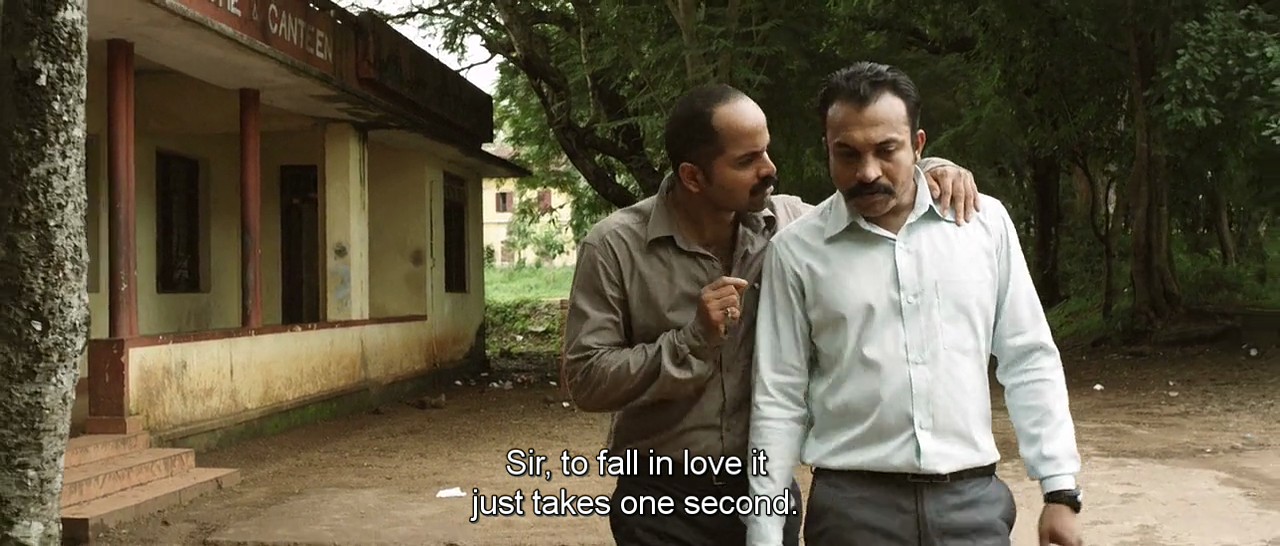
Coming to the crux theme of the second phase in George’s life, the magnetic Malar wins hearts with her smile, charm, straightforwardness. She becomes a constant source of happiness in George’s life and vice versa, the two shares a transcendent equation, the monsoons are the prime witnesses of their bond. There are breathtakingly beautiful frames of colors in which George and Malar paints their romance. Malar is synonymous to rains in George’s life, there is split second of shot, that represents Malar’s magnificent smile enclosed with a thundering black cloud, that small moment tells us the beauty of their relation. However, tragedy once again strikes George, where he wished he could relive in those glorious moments of love. Another stage, another story, another phase of moving on in life, but this time, he does not introspect about his life, rather gets his heart broken under unfortunate circumstances. George’s breakdown scene is easily one of the most touching scenes I have seen in recent years, it fondly reminded me of the iconic climax of 1983 released the Universal Star Kamal Hassan starrer “Sadma”, may be now we can guess the acknowledgements at the starting of the film.


We move forward to 2014, the rowdy George has now become an owner of a café, he is in his thirties, and tries to focus more on work rather anything else. The world for George is a different place now; it is only restricted to Café Agape filled with Cupcakes, exotic Pastries, soft breads, fresh coffee beans and attractive red velvet cakes. Destiny in collaboration with life gives George another chance to strike at the game of love; he meets Celine at his café, and shapes an affinity for her. George has evolved with time; he has actually matured in his idea of romance and life. He is not running after love, or acting madly/passionately in love, he is too tired pull off those tricks now, he looks for the bigger picture, longevity with someone. He is Crestfallen for a moment when he learns that Celine is already engaged to Roney (Played by the director Alphonse Puthren), who in turn happens to be a cocaine addict, which gives George a chance to bring back the rowdy version of himself back into existence and sort things out.

The three women; Mary (Anupama Parameswaran), Malar (Sai Pallavi) and Celine (Madonna Sebastian) act as catalyst in George David’s transformation from 2000 to 2014. They bring out a certain trait in George, which individually helps him grow stronger in life, each passing stage we see a different George with a common feature that he is searching for love. If Mary was the early morning breeze George was in search for, Malar becomes the pleasant smell of earth during rains in his life and Celine becomes the much-wanted sunshine he needs in life. However, it is the Magnetic Malar, which brings out the best moments in film.


There is a constant use of butterflies in the film, right from the first stage to the third, and we are told from a heavenly female voice “God unified the flowers which cannot move without butterflies, for you, flowers which can move, he bestowed to all of you butterflies as the emotion of LOVE”. I guess it is a fantasy scenario, which tries to link the role of butterflies with love. I guess that all the shots of colorful butterflies represent the anxiety associated with love (butterflies in the stomach). The kind of feeling, which is difficult to explain to someone else, but regularly persist in our senses. It might the amalgamation of all the chemical and hormonal process resulting in subtle hints to our body that we are acquiring this feeling called Love, and it is as if we see its visual representation in the form of colorful butterflies.        

The nature of any coming of age drama relies solely on the transformation of its central characters, how they mature in life in accordance with the kind of choices they make in life, letting go of certain feelings at certain times in life. Accepting failure/rejection and growing out of it. Premam is full of clichés but that does not make this film ordinary, it is the simplicity of characters and the world in which they reside is what makes them special.

The innocent George David ends up giving us joy with his quest to find love.  

Saturday, December 23, 2017

Thoughts on Insomniac City: New York, Oliver, and Me by Bill Hayes


“O: ‘The most we can do is to write – intelligently, creatively, critically, evocatively- about what it is like living in the world at this time” 


How will you react if someone looks dead straight in your eyes, and tells you in a firm voice that “At this moment, you are the most important person in the world.”

A sense of formidable assurance will hit you at the sweet spot of your heart; the much-wanted comfort in that firm voice will give you a sense of relief that no matter what, you are special and your presence does make a significance impact on someone’s life. 


This is one of the underlying scenarios, which forms the crux of Insomniac City: New York, Oliver, and Me written by Bill Hayes.

Set in the cosmopolitan jungle of New York, we do not read about the New York, which might be on the verge of an invasion from aliens. We do not read about the magnificence of Stark Tower complex located in midtown Manhattan. We do not read about the carnage that the several members of Avengers have brought in on the city. We do not see the New York, which Travis Bickle from Taxi Driver made us see through his eyes. Rather, we visualize a closer reflection of life in New York.

As the title suggest, the city never sleeps, there are always curious souls wandering aimlessly around subways, parks, on the streets and one such insomniac soul is Bill Hayes who, in his late forties makes a life changing decision and moves into the city of New York. Early in the book, he throws a familiar scientific term by the name of Agrypnia Excitata, a medical situation characterized by persistent Insomnia, over activity, mental confusion with dream enactment. He tells us that if we were to diagnose New York, it would surely be going through this medical condition, which he himself confirms to be going through mildly.  

Spring Shadows, Photo by Bill Hayes

The book starts with Bill narrating a devastating personal loss, the irony of which will make you wonder of how unkind being an insomniac can be. “Suffering a devastating loss is like suffering a brain injury, you walk around like a zombie, you can’t think straight, you feel drugged,” someone tells Bills, to which he thinks, “Sometimes you are drugged” it’s such a minor exchange of words filled with a sense of consolation which are so pure and genuine in their nature but at the same time, anecdotes like these is what made me think more about my own insomnia and the moments of personal loss. Bill meets many interesting people, who share some interesting aspects of their life, like using the term “disappear” in place of death, it made me wonder about the analogy of terms we use, to explain about the death of loved ones, surely it does represent a deeper connotation of our association with the person on a very personal level, they leave us physically but with a plethora of memories and moments to look after. Bill moves on in his life and discovers something on his own after his countless isolated nights “A thousand days is a thousand nights is a thousand chances to dream about him”  and recalls an out of the ordinary aspect from the Greeks; The god of sleep (Hypnos) has an identical twin, Thanatos, the god of death.     

Then what starts as a formal correspondence through letters between Bill Hayes and Dr. Oliver Sacks over the former’s book The Anatomist organically grows into something excessively special. It was the zest and the natural curiosity of discovering novelistic persona that shapes the bond of mutual admiration between the two. Dr. Oliver Sacks’ ability to look through Bill’s photographs from an altogether perspective, like comparing bare tree limbs to bundle of neurons in a closed system. Bill decides that he needs to get a fresh start, gets a one-way ticket, and like millions before and after him comes to New York, not specifically in pursuit of anything, but just to celebrate life the way he wants it to be.  Insomniac City is Bill Hayes love letter to two of the most important companions in his life, New York and Oliver Sacks. 

At Home, Photo by Bill Hayes

Bill Hayes explores New York and simultaneously his life. The unplanned encounter with strangers in the streets of New York yields him so many stories to remember. The weather of New York in which the multi color template of clouds play an important aspect throughout the book, the iconic Empire state building, the subways, dirty streets, cold nights, and taxicabs stuck in traffic, they all play a major role in Bill’s life, since he gradually transforms into a New Yorker, and accepts the city with all its detriments. Random stranger writing a love poem for Bill and coincidently meeting the same person two years later, this time the poem is about the sky under the stars. Preferring to stand rather than sit on a subway, never dozing off, never reading, as doing any of those things might make him miss a surprising site. There are many more such stories that Bill share with us. He deeply embraces New York and its people, and lives in optimism that city will repay him in some form or another, and eventually it does. He makes us see the city through his lenses (quite literally, since he captures many photographs). He captures moments of human love, people, strangers, lovers, acquaintances quite artistically without dramatizing the moment. Bill Hayes sees, values, experiences, untangles the simple yet the delicate complex nature of human emotions in New York.  It is the wonderfully expressed writing that one does not get a sense of time and space in accordance with the book, the random people coming into the life of Bill and leaving with an impact and a certain memoir of their own to share in future. The illustration of human emotions through photographs gives us a glimpse of how he intends to celebrate life in New York, both the photographs and the anecdotes of New York runs in a parallel narrative style of storytelling.  

Lovers on the Grass, Photo by Bill Hayes

"It requires a certain kind of unconditional love-to-love living here. But New York repays you in time in memorable encounters, at the very least. Just remember: ask first, don't grab, be fair, say please and thank you- even if you don't get something back right away. You will.” 

Dr. Oliver Sacks (O), the genius neurologist, writer, professor forms the significant draw in the book. The way Bill portrays him through his personal journal entries (idea of which was suggested to Bill by Dr Sacks himself that he must keep a journal) gives us a subtle hint of the kind of relation both of them shared. O didn’t know what or who the phenomenon known as Michael Jackson was, he had no attentiveness of the contemporary pop music, he didn’t owned any computer, didn’t use email or text, rather favored using his fountain pen. He spend almost three decades in celibacy, spending majority of his time in work, reading, writing, unlocking the mysterious mechanism around the captivating aspects of Neurobiology. He works on the principle of not fearing death as much as wasting life. For O, writing is more important than pain. He redefines intimacy in such an extraordinary manner that you cannot help but get amused by his notion of intimacy, love and romance. He wears swimming goggles while opening the bottle of champagne because, first he has never done that himself and second “just in case”.  

“I just want to enjoy your nextness and nearness,” says O.

He puts his ear to my chest, listens to my heart, and counts the beats.

“Sixty-two,” He says with a satisfied smile, and I can’t imagine anything more intimate.  

The conversations between O and Bill appear so simple, yet it is their normal routinely conversations that sparks the inquisitiveness to know more about them, their world, the way they visualize the importance of the clouds in the evenings, they way they tend to look from a scientific perspective to describe normal human activities.  The way O suddenly mumbles “Wouldn’t it be nice if we could dream together?”  The conversations at the opium den, where O gets stoned and exhibit his vast neuroscience knowledge and enjoys the coming out of the regular boredom, and discussing the thin difference between happiness and pleasure. The difference in both of their personalities can summed into a minor conversation where Bill point out that he has seen fireflies, to which O responds that swallowing more than three of those would result in death due to luciferase. Their relation is an ideal paradigm of the perfect balance between Science and Literature. Bill’s words and feelings are the poetry whereas O is the scientific instrumentalist of those words and feelings.

Throughout the deeply personal conversations, Bill Hayes gives us an unparalleled access to their love, to their world, and in a way tells us about the restrictions of human endeavors brought upon by time, space and medium needs to be respected. The acceptance of death at some point in life, holding onto grief, and then going on to celebrate death, and much more importantly celebrate “Life” is what makes this book extremely memorable and a delightful read. Perhaps I am not able to precisely explain what made reading this book a charming experience for me, but the writing is so personal and intimate, that you appreciate the beauty of it. If you want to celebrate life in ordinary moments or want to connect yourself again to the times we live, then Insomniac City awaits your attention. Bill Hayes awaits your attention.  


Sunday, November 12, 2017

Metamorphosis of Jordan

“I hear music when I close my eyes. When I open my eyes, the music does not go away. I often cannot follow the words that people speak, but I get the music of their soul. It is good that way, because words can lie but music cannot. Pleasant or disturbing, music is always the truth”- Jordan


Sometimes I marvel about the scenario how Imtiaz Ali would react to all the in-depth analysis around his films, his pleasantly realistic characters and their individual perception about love, life, dreams, freedom, and self-realization of their inner voices. People trying to decode the psychology of his characters, their motives, their state of mind at a particular scene, it must be a very fascinating and paradoxically surreal moment for him to read all the theories being put forwarded by people regarding the characters that he has created.
What quality does these Imtiaz Ali’s characters possesses for people to talk about them with so much passion and enthusiasm?

The answer lies in the question itself only, because they are “Imtiaz Ali’s” characters. 

One such fascinating figure from Imtiaz Ali’s universe that he introduced 6 years back to the world was Janardan Jakhar. A Delhi Boy who resents the fact that he has no pain in his life and has never experienced heartbreak. He is told that the emotional turmoil raised through heartbreak would eventually help him become a genuine and passionate musician.

Starts the journey of Janardan followed with a thunderous tune of an electric guitar from 
Orianthi Panagaris.

So where do we start from? Janardan’s impression that a completely different world exists inside video games, or the one who sprinkles alcohol around his face and collar, and act totally sloshed just so that he can mix up in the crowd. He also put forwards an interesting fact that guest at the wedding fantasize about the bride at night. He does not understand classic music, or he is unaware of the fact that he does, but it just does not go well with his sense of music. He leaves interviews midway without bothering to tell anyone, because he just does not care. 


Perhaps we should start with Jalal ad-Din Rumi’s lines that open the journey of Janardan “Out beyond the ideas of wrongdoing and rightdoing, there is a field. I’ll meet you there.”


Imagine a place, where we do not have to live in synchronization with the social conventions, our actions will not be judged in accordance to what is right and what is wrong. Imagine a place, so revered that we will be able to overcome the despair and misery surrounding our lives because of us trying to be different from what we actually are. There are no society expectations, no pressure to succeed in life in terms of the stagnant parameters of success in life. A place where anyone can run towards their dreams irrespective of the fear of it being reasonable or not.  A place where the impulsive nature of our soul guides us through the questions put forward by scenarios thrown into our way by life. A place where the radiance of the universe permeates through our consciousness and stimulates us to let things go. What is right and what is wrong is very subjective, but the core value that the meeting field brings is way beyond those circumstances.  
     
The two concepts, the meeting place and that heartbreak is necessary for peak creativity form the crux of Janardan’s metamorphosis into Jordan. The two concepts run parallel throughout the film; the need of the meeting ground carved into core idea of how creativity, triggered through deep sorrow is juxtaposed into the narrative. The differential layers of emotions vary in accordance to the mood of Janardan/Jordan and are intelligently conveyed through the lighting of the scenes. The initial life of Janardan is expressed through natural light, because Janardan is a typical Delhi boy, who has not yet discovered the world yet. When Jordan sings at live concerts, on several occasions under monochromatic shades or under suppressed colors highlighting the mood of his state along with signifying the lack of bright colors in Jordan’s life.           


Ustad Jameel Khan spots Janardan at Nizamuddin Dargah, which is the holy shrine of Hazrat Nizamuddin Auliya.  He was one of the most famous Sufis of the Indian subcontinents. Nizamuddin Auliya, like his predecessors from Chishti order focused upon love as a means of realizing God. Janardan, a bit hesitant in the initial days to mix up with the Qawaali team at the shrine organically gels with them through the magic of his music. He serves as a disciple at the shrine yet act a bit reluctant to ask for anything, and rather just stares with a sign of doubt. Gradually, it is his music that allows him to break the shackles of reluctance, and he utters-

Bring Morning rains on my body, and it helps me clean up the dark soul of mine, the drop of Nourishment that flows from yours, Oh Lord

It would be more appropriate to state that Janardan served as a disciple of a Sufi Saint, and it eventually helped him rediscover his music through a different perspective. Ustad Jameel Khan serves as a Messiah in Janardan’s life. He convinces an unenthusiastic Dhingra to give him a break and quotes “He is a big animal; he won’t fit in your small cage, he will create his own music, he is something else, the Almighty has blessed him, he has his Inayat (Grace)”. Ustad Jameel Khan seemed like a messenger of God sent to identify the ones who had God’s grace and fulfill their wishes. He kept track of his green colored Misbaha (Prayer bead) which is used to repeatedly recite prayers silently within the mind or aloud. He had two disciples with him, carrying his wheelchair, who appeared twins, with nearly same facial features and same clothes. According to Islamic tradition, the two kiraman and katibin (honourable scribes) are two angels called Raqib and Atid, believed by Muslims to record a person's actions, thoughts and feelings.       


If you go through the posters of Rockstar, you will notice a pattern of a strong color template surrounded by flames. I wonder if it symbolizes “Wings on Fire”, the name of Jordan’s concert. The man you see on the poster is not Janardan; he is Jordan, who is broken, empty, under immense pain, in quest of the meeting place, burning in the fire of his own strong emotions. He can only express his pain through his music, and yet cannot be heard. The posters featuring Jordan and Heer have an indispensable aura of enraged sexual energy. It is as if both of them want to shred all the inhibitions laid down to them by the society and get lost under the passionate fumes of loves. Meanwhile, the ones featuring Jordan alone denotes an intellect of Sufism hidden under his music. 


The transformation of Janardan into Jordan is organic, systematic and painful, Heer gives him this new name, Janardan unaware of the consequences that his life is about to undergo accepts the new name with an initial hesitation. The first point of transformation is through the song “Aur Ho”, where Jordan is full of sexual energy, and by this, I do not mean he is full of lust; it is rather the restlessness after a string of passionate kisses and intimate moments that has turned him helpless against his conscious judgment of what is right and what is wrong. He constantly wants to look into the eyes of Heer, he cannot accept Heer turning her face away. He wants to feel the sensations brought because of his hands touching her skin.  


“I have become a string tangled in wish, untangle me
I am a knock and you are like closed doors, open
O helpness staying in the heart,
come, live and while living, live the dream..
There should be more, more noise of breaths and move towards the flame”


The moment that catalyzes the transformation occurs when the people are aware of his music, his eccentric personality, and wants to pass on a judgment on his personal space, they are more interested in his personal actions rather than his music, people wants to cash-in on his music through his idiosyncratic nature. Dhingra Saab, knows the value of public image, because according to his market experience “Everything is Image, and Image is everything” and that is how he brands Jordan’s first album as “Negative” because in media only negative prevails. Jordan expresses his volatile reactions through the song “Sadda Haq” where he starts with these lines-


In this world of you people, at every step, a human is wrong.
Whatever I feel is right and say,
you call it wrong, if I'm wrong then who's right?
Should I send you a request
for me to live with my own wish?
Means you all have a right on me
more than I do it's my right, put it here and give it to me

  In the middle of the concert, Jordan narrates an incident to the public about how many years ago; there was dense and fearsome jungle at this very right place, which was converted into a city with neat and clean houses, wide straight roads, everything with proper planning. The day the jungle was torn down, a flock of birds left the place forever. Jordan mentions that he is searching for those birds. This part left me wondering whether Jordan at this point is not aware of the meeting place, and those flock of birds went into that sacred space, far away from the humanity.

Does the search of those flocks of birds guides Jordan to discover the meeting place?

At one point in the film, post the transformation of Janardan into Jordan, there is a pause or perhaps a Trans like state where Jordan stands still, as if Jordan wants time to stand still. He recalls the time spent at the shrine, may be looking for same kind of solace that he found during his stay at the shrine. There is also a shot of him shivering with cold and witnessing sunrise, still longing for something even he has not determined yet. The scene between Khatana and Jordan works on the principle of paradox. Even Jordan agrees with his queries and to his best ability tries to explain his state of mind but fails. Jordan has fallen into the gap of contradictions, which is explained so aesthetically via the dichotomy of fame. He is no more Janardan from Hindu College, who had heated arguments over little Chutney offered for two Samosa’s, he is now Jordan, the rockstar. His friends are not interested in understanding his mental frame of mind; rather their priority lies in getting as many pictures as possible with the celebrity that Janardan has become.     

In a Film Companion interview, Imtiaz Ali mentioned that in retrospective, the film has defects after a particular point; he says that how beautiful it would have been if they had just got together and after a certain time realized that they have nothing in common and are not compatible. Ranbir Kapoor points that it is a perfect film that it was necessary for Jordan to get heartbroken towards the climax and end their story the way it ended.


6 years have passed since the release of the film, but the character continues to grab our attention, A.R.Rahman’s sensational soundtrack refuses to leave our mind, the magic delivered through words by Dr. Irshad Kamil continues to make us in awe, the soothing voice of Mohit Chauhan always brings a sense of calmness all around. Each song creates a different vibe and narrates the story in itself. Jordan’s character left an indelible mark for every protagonist suffering under the effect of love; the closest a character has come to Jordan is Arjun from Arjun Reddy. The two seems different sides of a coin, both flawed in their own way yet they both engross us in their stories, in their idea of love. I found Arjun a far more evolved version of Jordan. Arjun does not shy from fulfilling his physical needs whereas Jordan tries but fails miserably in the same case. Arjun is optimistic about his love, while Jordan remains stagnant in his life and chooses to remain enclosed in a shell of his own emotions during the period when he is away from Heer. The common string between the two that I found is that they are highly polarizing characters and they evoke polarizing emotions from the people, you either love them unconditionally with their flaws or loathe them in regards to their emotional shortcomings.      

Jordan is aware of the void in his life, the angst that engulfs him every moment despite having everything that he always wanted. He is enraged within, burning in his love for Heer. There comes a point where Jordan does not want himself to be heartbroken, he just want to be with Heer, but it is too late for him to realize this. The path of destruction that he embarked on has eventually broken his heart and shattered the innocent Janardan hiding somewhere within Jordan. All he wanted was to be with Heer in a world of their own, where they can live in solace, with no one to judge them, question their actions. I do not want to believe that Heer left Jordan all alone to suffer even more, I tell myself that they reunited at the meeting ground where the flock of birds resided. They did not deserve the world we live in; they deserved a far more suitable place for their love. 


Saturday, November 4, 2017

The Journey of Suffering with Arjun Reddy

“Man must be sustained in suffering by a hope so high that no conflict with actuality can dash it- so high, indeed, that no fulfillment can satisfy it; a hope reaching beyond this world”
Friedrich Nietzsche, The Antichrist 


In the initial scene of the film, we see Arjun’s grandmother candidly narrates a small incident from Arjun’s childhood with a deep metaphor about the stubborn nature of humans. She mentions about the Sages, Saints, Goddesses, birds and the creatures of the sea being vulnerable to change with respect to time. Then, she questions the human resistance to the course of change and even after accepting that change, there is a bundle of grief. Her simple and resounding rationalization is “Why grieve on incidents that are both unforeseen and predictable”. She further recounts about Arjun’s deep attachment with a doll draped in a white gown. One day, when the doll is lost and Arjun despite lot of attempts is unable to find her, he sleeps in sorrow after constantly asking his grandmother to help him find the doll. Director Sandeep Reddy Vanga has told us a major characteristic of the protagonist, he is stubborn about change, yet accepts it with unhappiness, but does not, under any circumstances leave “Hope”.

Arjun Reddy (Vijay Deverakonda), found in weird conditions on several occasions under the influence of alcohol and drugs, is in desperate need for a physical interaction, and when his quest is rejected from several feasible options, he picks a handful of ice and place it down his jeans, probably an effective but definitely not a subtle way of calming the raging hormones.

Arjun Reddy is going through a drastic transformation in his life, post a major incident, yet he refuses to come out of it and move on in his life, like most of the people around us do, but no, not him, he is Arjun Reddy, a medical prodigy, the one who refuses to bow down to anything which under his judgment and sensibilities is not right.  He is aware about the 690 carcinogenic agents, 4 cancer-causing factors and 48 COPD diseases found in cigarettes, yet he smokes, because it has become his habit.  Nuance is not Arjun’s cup of tea, but a strong trait for his character, that the director paints on the celluloid. Arjun speaks with his heart, no matter what the situation is, he can easily make you fall in love with him, at the same time, the anger issue he goes through, the sudden mood swings might make you despise him. 


The moment he sets his eyes on Preeti (Shalini Pandey), he is sure about his feelings, and does not take too much time to amplify his notion of love. It’s the subtlety of his character through which a better perception of his inner character can be guessed, like for instance, when Preeti’s father cleverly tries to suggest that he should take care of Preeti as an elder brother, he instantly rubbish off the suggestion, citing a reason that he doesn’t have a sister, and won’t be able to connect emotionally with her as a brother, so it’s better she remains a junior for him. You are not sure, what Arjun might do in the next moment; he might unintentionally objectify girls because of their weight and tell you with a straight face that fat chicks are warm and loyal, so friendship with them would last longer. He might just casually barge into girl’s hostel and lay down under Preeti’s lap as if it is the only place, he will find solace.


The film at some point does feel like a documentary on this fascinating character, but yet it never provides a dull moment, the narrative of the relationship between Arjun and Preeti is told through the lens of Arjun, and not Preeti. We do not get into her frame of mind, her perspective of being in love with Arjun Reddy, off using his influence to avoid ragging, her thoughts about strategies of studying various topics of anatomy through diagrams drawn on her skin by Arjun, her tactics of calming the spontaneous anger that might burst out of him at any moment. It seems likely that Arjun act as a catalyst in Preeti’s life, to help her open up a bit and embrace the love he has to offer. Honestly, I am not even bothered about any other point of view, because Arjun has all my attention. However, the impulsive nature of Arjun Reddy is put to a test in a crucial moment in the film, where we are introduced to a cockier version of him, where he will curse, give deadlines, immerse himself in alcohol, find something irrelevant like someone’s hair (Probably Preeti’s) on his bed, do pushups (way to calm himself down).


There is a gradual transformation of Arjun Reddy in both physical and mental aspect. He flaunts a thick beard, which often might be misinterpreted as sign of toxic masculinity (Cumulative of his actions). He is adamant in his actions and explains to his friend that his situation is similar to a girl going through her periods, instead of being supportive, affectionate, and attentive, people around him are neglecting his sorrows. There are numerable scenes, where Arjun show signs of being under the influence of “Dev D” syndrome through the aid of alcohol, drugs, and casual sex. He even joins a group meant for people failed in Love named “Love Failure Support Group” and solves the questions in order for a group conductor to assess Arjun’s pain. Arjun’s grandmother mentions that “Suffering is very personal”, and sums up the situation that Dr. Arjun Reddy has put himself in. Arjun has indeed embarked on a personal journey of suffering with loads and loads of hope, in search of peace of love that he found under the lap of Preeti; there will be moments of heartbreak, loneliness, self-discovery, a moment where we might see a glimpse another shade of who actually Arjun Reddy is.


We are spectators of his journey. He will be judged through our patriarch opinions; anti-feminist judgments, hypocrite nature. We will applaud/notice him for his drinking stamina, his style of inhaling a thin layer of cocaine, his style of smoking, his obsession about riding solo on his Enfield, his idea of hating good-bye, his habit of suddenly doing push-ups while pondering over something, his precision about not using suture on underage people, his notion of being in love with oceans, his strong sense of opinion that he had a benchmark love story, his ability to visually represent his thoughts about a topic from human anatomy, his stubbornness of not agreeing to take money from friends when he is broke, his frank belief that other people are not worthy of love marriage.


Arjun Reddy is an up-close encounter with this fascinating character; let’s witness his personal journey of suffering. 

Sunday, October 8, 2017

The Insomniac Diaries: yearning for break of dawn

The last refuge of the insomniac is a sense of superiority to the sleeping world”
 Leonard Cohen
“All bad things must come to an end”

 I read the line from the breaking bad poster stuck on the wall, just in front of my bed. I broke out of the comfort of warm blanket and immediately felt a twinge of coldness in my knees. I washed my face with cold water just to alert my senses.

I went to the balcony and thought about the various things going in my mind for the last couple of days. I ended a five-year long relationship with the girl, I thought I was going to marry and get old with. I had expressed extreme sympathy for a friend who became a victim of domestic violence. I resurrected a person from attempting suicide; I had a cousin brother in London who was battling with life with a blood clot inside his brain.

Words like guilt, love, expectations, frustrations, loneliness, mental tiredness and many more frequently used terms from the same genre became a regular part of my life and now I treated them merely as tools to express my emotions.

My life was like boxer standing in the ring and trying to defend the incoming punches, I was standing in position where I had no time to recover and get stable to give my own knockout punch.

I went through a lot of mixed emotions, guilt of not being loyal towards the person who cared for me, being a little selfish about my own affection, lonely off being not able to find a single person in my phone contacts to share my feelings with, sensible of not letting someone end his life just because he failed in his life.

I got restless, decided to get back inside the room to place myself again under the comfort of the warm blanket. I stared at the static fan and off-white colored walls and thought about the various nights I had spent thinking about improving my life and making it a better place to live. The very next moment another thought struck me, about how in all those aspects I was a miserable failure.

My life was slowly becoming an amalgamation of despair and sadness, where all I did was live my life in two images. One where I presented myself as a person of how the society wanted me to be and secondly the person I wanted to be. However, now come to think of it, we all are living our lives in the same pattern of duality.

It was not the lack of sleep that was turning my thinking process into a more complex system, it was the lack of hope. Lack of happiness that you get from little things you go through in life, the atmosphere of an early morning cool breeze, sunshine in the dawn, a moment when you see flock of birds twittering their way into the blue sky not worrying about the destination. People going for their usual morning walks and being internally happy that they are taking care of their body, The huge crowd assembling near the tea stall for their early morning tea, mothers preparing lunchbox for their children, that little kid crying his heart out in a emphatic way to tell his parents that he doesn’t want to go to school. I missed these small ordinary moments to be cheerful.

Photo by Zac Durant on Unsplash

When Life starts throwing random punches towards me, I should behave like the great Jake Lamotta- let it beat the hell out of me, but not be able to knock me down. With that thought, I realized how true the breaking bad poster stated, that all bad things must come to an end and so will my sleepless nights would one day see the end of darkness.